
Program notes
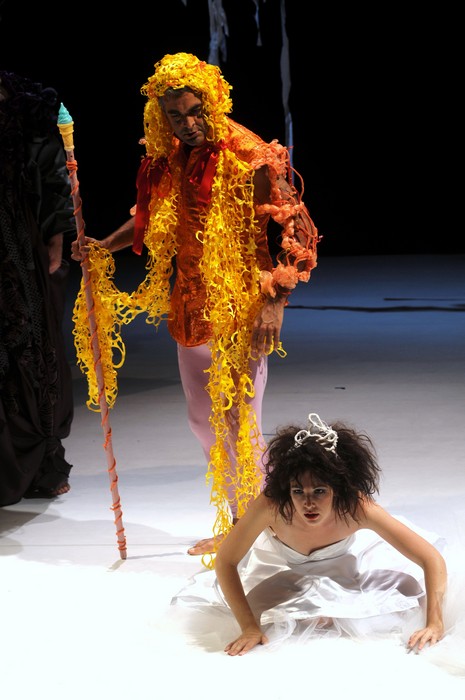
La Bisbetica is an opera buffa in two acts based on William Shakespeare’s The Taming of the Shrew. The work transforms the original play into a contemporary Italian-language opera, keeping Shakespeare’s sharp humor while exploring the relationships among Caterina (Kate), Petruccio, Bianca, Lucenzio, and the colorful circle around the Minola household.
Characters
The principal roles are:
- Caterina (Kate) — lyric mezzo-soprano
- Petruccio — lyric baritone
- Bianca — light lyric soprano
- Lucenzio — lyric tenor
- Battista — lyric low bass
- Tranio, Grumio, Drumio, Tailor, Officer — baritone buffo
- Vincenzo — bass (may also be sung by the Battista singer)
- Merchant — tenor (may also be sung by the Lucenzio singer)
- Riverso — one of the male cellists
- Lute Tutor — the other male cellist
If the three cellists appear on stage, they should be cast as two men and one woman.
Act I
There is turmoil in the Minola household. The beautiful Bianca wishes to marry, but her father Battista has decided that she cannot wed until her older sister, the “shrewish” Caterina, finds a husband. Lucenzio, a wealthy nobleman from Pisa, falls in love with Bianca at first sight. Realizing that he cannot openly court her until Caterina is married, he disguises himself as a tutor in order to remain close to her. Meanwhile, Petruccio—a rich nobleman from Verona—arrives in Padova, hears that Caterina has a generous dowry, and decides to woo her despite her fearsome reputation. The act ends with the surprising wedding of Petruccio and his shrew.
Scene I
In the street behind the Minola garden, Caterina torments her younger sister. Battista declares that Bianca cannot marry before Caterina, though he offers to hire private tutors for both daughters. Lucenzio arrives in Padova with his servant Tranio, sees Bianca, and instantly falls in love with her. Together they devise a plan: Lucenzio will disguise himself as a tutor named Cambio while Tranio impersonates Lucenzio to avoid suspicion from Lucenzio’s father.
Petruccio appears, confiding to his servant Grumio his desire to find a rich wife. Learning about the “unbearable shrew” Caterina and her dowry, he decides that she is the perfect match for his ambitions.
Scene II
Petruccio introduces himself to Battista and asks for Caterina’s hand. Battista is astonished that anyone would wish to marry her and lists all the reasons she would make a terrible wife, but Petruccio responds by boasting of his own exploits and his ability to “tame” her. Lucenzio—already disguised as Cambio—overhears and, wishing for Caterina’s marriage so that Bianca might be free, helps Petruccio persuade Battista.
Tranio, dressed as Lucenzio, offers a generous dowry for Bianca’s hand and presents Riverso and a lute tutor as additional teachers. Battista accepts them as tutors. From Caterina’s room, the poor lute tutor emerges with the instrument smashed over his head, proof of her temper. Petruccio is only more intrigued and determined.
When Petruccio and Caterina finally meet, he boldly announces their future marriage, enraging her and triggering a spirited confrontation. Yet Petruccio convinces Battista that things are going well and insists they will marry on Sunday. Battista agrees, provided he can also secure a satisfactory match for Bianca.
Scene III
In Bianca’s studio, Riverso and Cambio compete for her affection. Bianca prefers Cambio, and the two lovers speak in coded phrases during a “Latin lesson” as Lucenzio reveals his true identity and his desire to marry her. Tranio enters, frustrated that he has not yet found anyone to impersonate Lucenzio’s father, Vincenzo. The lovers hatch a plan to elope if necessary.
Scene IV
On the wedding day at the church, Caterina’s family anxiously awaits Petruccio, who arrives scandalously late and in wildly inappropriate clothes. After the chaotic ceremony, he insists that Caterina leave with him immediately, refusing to let her stay for the wedding banquet. He drags her away as the Minola family protests.
Act II
Petruccio decides to “tame” his wife with exaggerated sweetness. He keeps Caterina chained to a radiator (or giant cupcake) and feeds her nothing but sweets and cakes, insisting that everything he does is in the name of love. Gradually her resistance begins to soften. Meanwhile, Lucenzio secretly marries Bianca, but their plans are threatened when his real father arrives and discovers that a merchant has been impersonating him. After a series of misunderstandings, the families are finally reconciled, and Petruccio and Caterina emerge as a surprisingly loving couple.
Scene I
Inside Petruccio’s house, Caterina has been chained for six days and nights, forced to eat nothing but sweets. Disgusted and exhausted, she laments her fate in the aria “Incatenata a questo radiatore!” and, in the process, admits her love for Petruccio. He, in turn, declares his intention to tame her through “sweetness,” even as he struggles with his own feelings.
Petruccio orders his servant Drumio to cover her in powdered sugar and continues his comic cruelty (march: “Marzapan! pan! pan! pan! pan!”). He then calls in the tailor to show the beautiful dress and hat he has ordered for her, only to reject them as unsuitable for someone who is not yet “gentle.” They will go to Bianca’s wedding in their current clothes.
Scene II
On the road to Padova, Petruccio tests Caterina by insisting on absurd statements—such as claiming the sun is the moon—and demanding her agreement. At first she refuses, but, worn down and delirious, she begins to comply. When they encounter Vincenzo, Petruccio insists that he is a beautiful young woman, and Caterina plays along, demonstrating how completely she has learned to follow his whims. Once they reveal Vincenzo’s true identity, they all head toward the wedding.
Scene III
In front of Lucenzio’s house, Vincenzo confronts a merchant dressed in his clothes and pretending to be him, leading to a chaotic sextet (“ladro, bandito, mi ha rubato il nome”). The confusion continues until the real Lucenzio appears and explains the plot. In the end, Caterina and Petruccio are left alone; he finally frees her from her chains, and they share a tender moment.
Scene IV
Back at Battista’s house, Bianca and Lucenzio arrive as he declares his love in the aria “L’amore ha compiuto prodigi.” Bianca pleads with her father to accept Lucenzio (“Padre caro, qui avete un nuovo figlio”), and Battista is moved to bless their marriage.
Petruccio then proposes a wager to prove which wife is most obedient. The husbands will summon their wives, and the one who comes first will win the bet for her spouse.
Scene V
To everyone’s surprise, Caterina is the only wife who comes when called, while Bianca sends word that she is “busy.” Caterina then brings Bianca in, who is furious to learn she has been part of the wager and that Lucenzio has lost money on the bet. To calm the situation, Caterina describes the virtues of the “perfect wife,” gradually diffusing the tension. Petruccio is delighted to have won the wager, and the ensemble closes the opera with a jubilant march (“Marzapan! pan! pan! pan! pan!”) as everyone heads off to bed in high spirits.
Instrumentation & duration
Instrumentation: Opera buffa in two acts for solo voices and chamber orchestra, with on-stage
cellists appearing as characters in some productions.
Duration: ca. 1:35:00.
Video excerpts
Trailer — also available on YouTube.
Aria “Incatenata a questo radiatore!” (Act II) — also available on YouTube.
Duo “Buongiorno, pasticcina” (Act I) — also available on YouTube.
Purchase options
All PayPal buttons below open in the floating cart (top/right or bottom/right on mobile) so you can combine items before checkout.