
Program notes
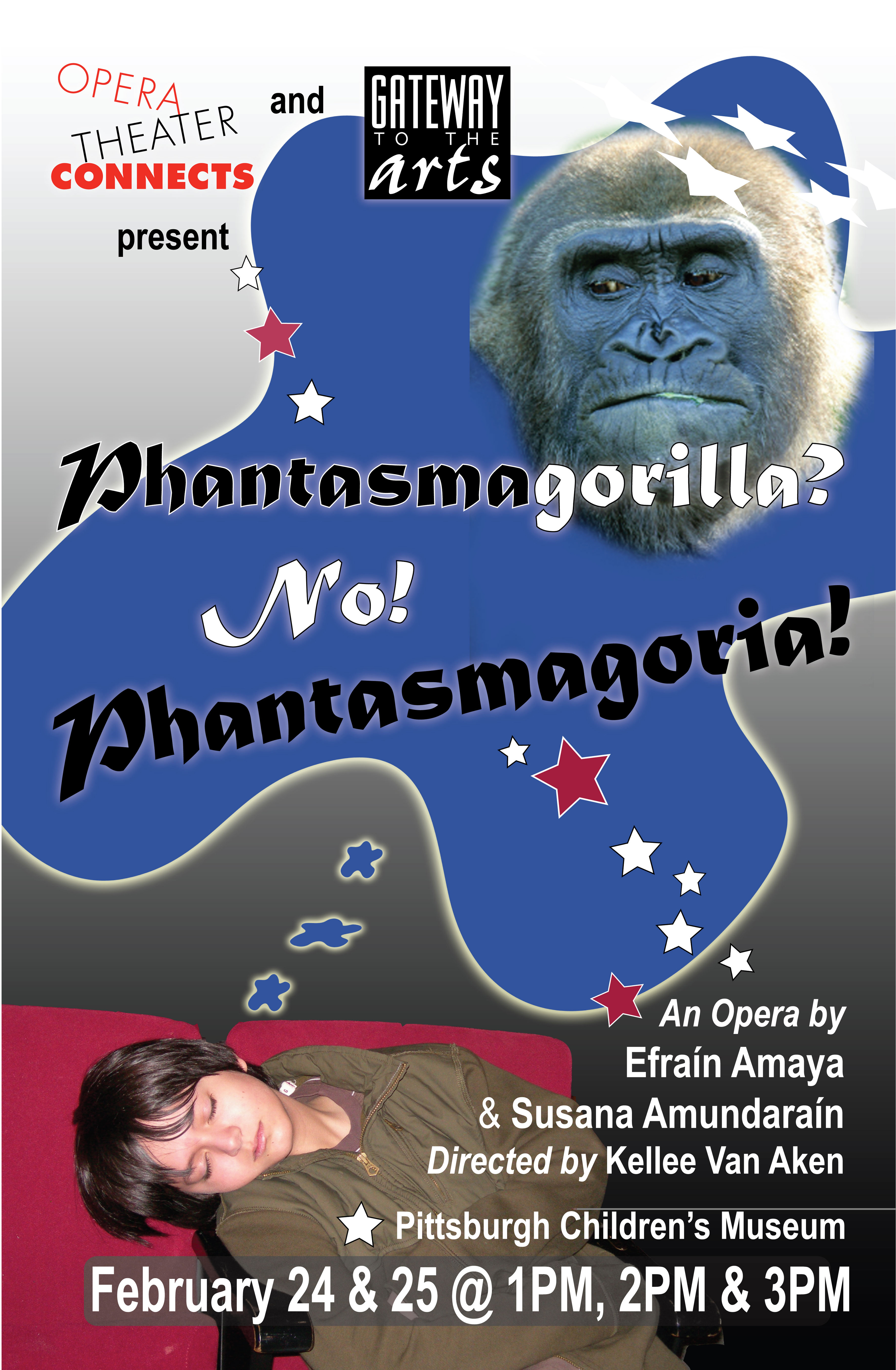
Phantasmagorilla? No! Phantasmagoria is a children’s opera that takes place during an evening of classical music. A family goes to hear an opera titled The Ghosts of the Opera. The parents are enthusiastic, and their teenage daughter, Nessie, is mostly excited about the theatre, the people and the set. Bernard, their ten-year-old son, is openly hostile to the idea of classical music and opera. He complains, resists, and promises to fall asleep in protest.
The stage space is divided into two levels: a lower level for the orchestra or piano, and an upper level for the “audience,” a small group of characters who will gradually turn into the singers and figures in Bernard’s dream. As the family takes their seats and continues arguing, the orchestra tunes. The house lights flicker three times to announce the start of the show. The opera begins—and, as promised, Bernard soon falls asleep.
From this point on, the members of the audience become the characters in Bernard’s dreams. The music and stage action move from everyday reality into a dream state. The dream is broken into a series of short, interconnected scenes—little flashes of memory and fantasy—inspired by the opera’s title and by Bernard’s own fears and desires.
Characters
- Mother / Grandmother — Coloratura soprano. The Mother may also sing the role of the Grandmother in Bernard’s dream.
- Father — Lyric baritone. Bernard’s father, who wants to share his love of music and help his son through his fears.
- Bernard — Boy soprano or lyric mezzo-soprano. A boy of about ten who insists he dislikes classical music and opera.
- Nessie — Music-theatre soprano. Bernard’s older sister, around sixteen, excited by the social and visual side of the evening.
- Mrs. Cirkem — Lyric soprano. Bernard’s science teacher, who later appears in his dream as part of the gorilla chorus and may also sing the “opera singer” role.
- Opera Singer — Lyric soprano, may be doubled by the same singer who performs Mrs. Cirkem.
- Audience Woman / Gorilla Chorus member — Mezzo-soprano.
- Mirage — A silent girl who may also be a dancer; she appears as a fairy-like figure in Bernard’s dream.
- Grandmother — May be sung by the same singer as the Mother.
- Gorillas — The gorilla chorus (all except Bernard and Father).
Story line
Introduction
The orchestra (or piano) begins to play. On stage, there are extra-tall costumes that seem to float high above, with masks and elements that evoke a theatre space. Somewhere, the title The Ghosts of the Opera is visible. The “audience” consists of seven chairs. A woman and a girl in bright blue-green are already seated; Bernard’s science teacher is also in the audience. Bernard and his family enter, still arguing. After the first lines of the singer starting the opera, Bernard falls asleep, and the first dream image appears.
Dream I
A ghostly presence develops and gradually reveals itself as Bernard’s grandmother. After some amusing back-and-forth, it becomes clear that she is not a frightening ghost at all, and certainly not one of the “ghosts of the opera.” The scene gently undercuts Bernard’s expectations about fear and the supernatural.
Dream II
Bernard’s sister, Nessie, appears in the form of an angelic ghost or guardian angel—always hovering near him. She follows him through the dream, watching over him with affectionate exasperation.
Dream III
A woman wearing a gorilla mask appears. Bernard wonders who she is; this turns out to be Mrs. Cirkem, his science teacher. Other figures join her as gorillas—his favorite animals. Through them, he is confronted with the idea of possible extinction and environmental danger. Bernard struggles with thoughts of ghosts, death, and the fragility of life.
Dream IV
Bernard’s parents appear, at first as a transition and then more directly. Bernard finds himself seemingly alone in a slightly nightmarish setting. His father steps forward to confront him—not in anger, but out of a desire to help his son face his fears. A short scene of shadows and heightened emotions unfolds, expressing the tension between them.
Dream V
Although Bernard is still afraid, he is intrigued by the silent girl who has been peeking at him throughout the evening and who now emerges more clearly from the shadows. Her presence is mysterious but not threatening, and Bernard’s curiosity begins to win over his fear.
Dream VI
Bernard and the girl, Mirage, engage in a strange dialogue in which she never speaks with words. She communicates only through gestures and music. She is more like a fairy than an ordinary girl. Bernard hears an enchanting, wordless chorus and believes the music comes from her. He begins to think he might be in Heaven. His parents, now seated in the “audience,” watch them. Bernard drifts into a deeper sleep as the opera singer on stage finishes her lines. The audience characters return to their seats.
End
A burst of applause wakes Bernard. His family tells him he has missed the show, but he is certain he has experienced a real opera of his own. He excitedly describes the silent girl, the gorillas, and the music he heard from “Heaven.” Bernard is convinced that his dream was the true opera—and, without realizing it, he has opened himself to the world of music and imagination he had rejected at the start of the evening.
Performance & materials
Genre: Children’s opera for family audiences.
Year of composition: 2006.
For information about parts and performance materials, please visit the Rental & Licensing page or contact LaFi Publishers directly.
The recording of Phantasmagorilla? No! Phantasmagoria is available on Spotify .
A recording of Phantasmagorilla? No! Phantasmagoria can be viewed on YouTube.
Purchase options
Use the options below to order the full score or vocal score for Phantasmagorilla? No! Phantasmagoria. The PayPal button opens a classic PayPal cart window; you can also use the floating Cart button (top/right or bottom/right on mobile) to view your cart.